
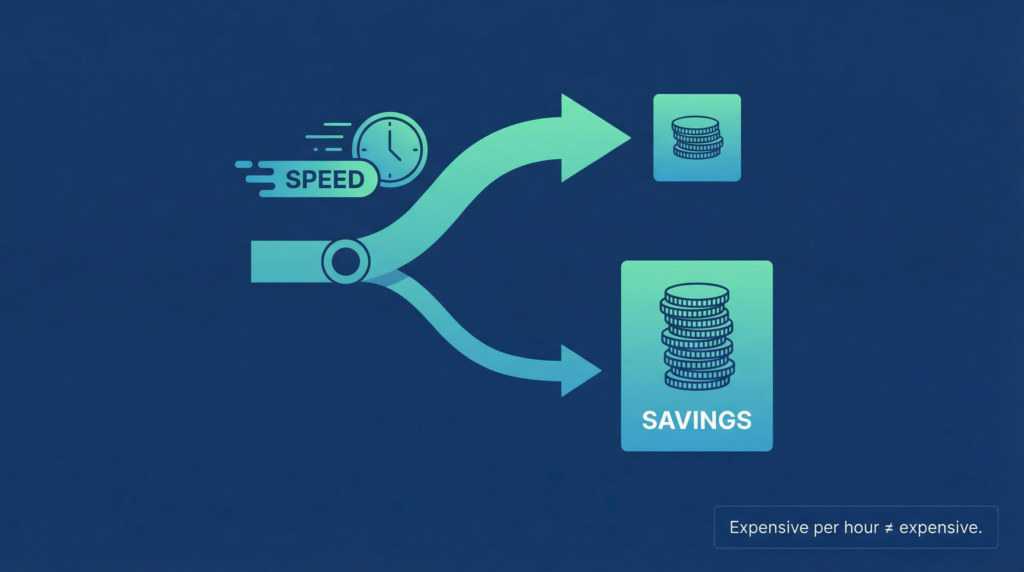
If you’re comparing day rates or hourly rates, a senior VibeCoding engineer will often look expensive. Two times a “normal” rate, sometimes more. That comparison is misleading. What matters for the business is total cost and time to outcome—and on that score, the expensive-per-hour engineer often wins. This article is a blunt look at why: the math, the trade-offs, and how CedrTech turns higher hourly rates into real savings for the project and the business.
Why the hourly rate is the wrong thing to optimise
Most procurement and many founders think in rate. “Engineer A is $50/hour, Engineer B is $100/hour—A is cheaper.” That’s true only if A and B deliver the same outcome in the same time. They usually don’t. A senior engineer who works with VibeCoding and AI-assisted tooling can finish in one week what a junior or mid-level team might take a month to deliver. So you’re not comparing “$100/hour vs $50/hour.” You’re comparing “one week at $100/hour vs four weeks at $50/hour” — and suddenly the “cheaper” option costs twice as much in both time and money. The unit that matters is total project cost and calendar time to delivery, not the number on the rate card. Expensive per hour does not mean expensive for the business. Cheap per hour often means slow, and slow is expensive.
The math: time × cost × iterations
You can make this explicit with a simple model. Call it:
Total cost ≈ (hourly rate) × (hours to deliver) × (number of iterations)
Scenario 1 – “Cheap” team.
Rate: $50/hour. Time to deliver a first version: 400 hours (about 2.5 months with one person, or one month with a small team). One iteration.
Total: 400 × $50 = $20,000, and you get the first version in roughly 2.5 months. If requirements change and you need a second iteration, add another chunk of time and cost. Say another 300 hours: 300 × $50 = $15,000. Two iterations: $35,000 and a lot of calendar time.
Scenario 2 – VibeCoding engineer.
Rate: $100/hour (2x). Time to deliver the same scope: 80 hours (about 2 weeks)—because one senior with the right tools can move 5x faster on many tasks. One iteration.
Total: 80 × $100 = $8,000, and you get the first version in 2 weeks. Need a second iteration? Another 60 hours: 60 × $100 = $6,000. Two iterations: $14,000 and a fraction of the calendar time.
So in this simplified comparison: the “expensive” engineer delivers in 2 weeks at $8k per iteration; the “cheap” option delivers in 2.5 months at $20k per iteration. Same scope, same number of iterations—the higher rate wins on both cost and speed. The multiplier isn’t made up: teams that use VibeCoding and AI-assisted development routinely see 3–5x productivity gains on appropriate work. So “2x rate, 5x speed” is a plausible, conservative frame. And the more iterations you run (which is normal in product work), the more the gap widens. More iterations mean more calendar time and more hours for the slow team; for the fast engineer, each iteration is shorter and cheaper. So: expensive per hour ≠ expensive for the business. Often it’s the opposite.
Why VibeCoding engineers cost more per hour (and why that’s rational)
A VibeCoding engineer is typically senior: years of experience, strong judgment, and the ability to work with AI tools without losing quality or direction. That profile commands a higher rate. You’re paying for scarcity—there aren’t many people who can own a feature end-to-end and ship fast—and for reduced risk. A senior who ships in two weeks rarely leaves you with a mess; a cheap team that ships in three months might hand you a codebase that’s hard to change or extend. So the higher rate reflects both productivity and quality. It also reflects the fact that this kind of engineer doesn’t need a big supporting cast. You’re not paying for a project manager, a tech lead, and three developers. You’re paying for one or two people who can run the project. So the blended cost—total spend divided by output—often drops even when the nominal rate is high. Again: expensive per hour does not mean expensive for the business.
Where the “cheap” option actually gets expensive
The hidden cost of the “cheap” team isn’t just the raw hours. It’s delay. Every week of delay is a week of lost opportunity: later launch, later learning, later revenue or cost savings. It’s also rework. Slow cycles mean feedback comes late. When the first version finally appears, you discover that the spec was wrong or the market moved. Fixing that is expensive—more hours, more iterations, more calendar time. And it’s coordination cost. More people and more time mean more meetings, more handoffs, more “alignment.” That’s real cost, even if it doesn’t show up as a line item on the engineer’s invoice. When you add it all up, the cheap-per-hour option often has a much higher total cost of ownership: more money, more time, and more risk. A VibeCoding engineer who costs 2x per hour but delivers 5x faster avoids a lot of that. You pay for speed and focus. The business pays less overall.
How CedrTech turns higher rates into real savings
At CedrTech we staff projects with senior engineers who work with VibeCoding and structured use of AI. Their rates are typically higher than a generic offshore or junior team. Our pitch isn’t “we’re the cheapest per hour.” It’s “you’ll spend less on the project and get it sooner.” We get there by: (1) Faster delivery. Same scope in a fraction of the time, so total labour cost goes down even when the rate is higher. (2) Fewer people. One or two seniors instead of a large team, so less coordination and less overhead. (3) Fewer iterations to get it right. Because the first version is built by someone who understands the problem and the stack, you need fewer rounds of “fix this, change that.” (4) Clear scope and expectations. We’re not selling infinite scope; we’re selling a defined outcome in a defined time, so the total cost is predictable. The result: higher hourly rate, lower total project cost, and faster time to value. That’s how we turn “expensive per hour” into real business savings. We’re happy to show the math on a concrete scope so you can see what it would mean for your next project.
How to compare offers when rates differ
When you’re comparing vendors or hires, don’t stop at the rate. Ask: “For this scope, how many hours do you estimate, and what’s the total cost?” Then ask: “How many iterations do you expect before we have something we can ship or test?” Multiply hours by rate and add a realistic number of iterations. That’s your comparison base. If one team is half the rate but needs four times the hours and two extra iterations, they’re not cheaper – they’re more expensive and slower. Also ask about who actually does the work. A low blended rate often hides a mix of juniors and seniors; the effective speed may be lower than a small team of seniors. And factor in your own time: more iterations and more delay usually mean more of your time in meetings, reviews, and re-specifying. Your time has a cost too. So the comparison that matters is: total cash out, total calendar time, and total risk. Rate is just one input. Expensive per hour ≠ expensive for the business — and the only way to see that is to run the full math.
When the “cheap” option might still make sense
Being blunt: the cheap option can make sense in a few cases. If the work is trivial, highly repetitive, and unlikely to change—e.g. a one-off migration with a fixed spec—then throwing more cheap hours at it might be fine. If you have infinite time and no opportunity cost, then minimising rate can look rational. And if you’re not sure you have a real product yet and you want to “try something” with minimal commitment, a very small cheap team might be a way to explore—as long as you don’t confuse that with building a product you’ll scale. But for most serious product work—where scope shifts, quality matters, and time to market matters—the math favours the faster, more expensive-per-hour engineer. You want fewer iterations to outcome, not more months of burn. The development speed of a small, senior team using VibeCoding and modern tooling isn’t a luxury; it’s a way to keep software cost under control. You pay more per hour and less per project. That’s the trade we’re optimising for.
Bringing it together: expensive per hour ≠ expensive for the business
The headline is deliberate: a VibeCoding engineer may cost 2x more per hour but deliver 5x faster. When you multiply it out—time × cost × number of iterations—the total project cost and calendar time often drop. So the right question isn’t “what’s your rate?” It’s “what’s the total cost and timeline for this outcome?” CedrTech is built around that. We offer VibeCoding engineers who look expensive on a rate card but make the project cheaper and faster in practice. If you care about total cost and speed, that’s the trade you want. Expensive per hour does not mean expensive for the business. Often it’s the opposite.
keywords: VibeCoding engineer, development speed, software cost, CedrTech