Key Takeaways
- Custom marketplace development becomes essential when you move beyond simple listing-based models and need multi-sided logic, Web3 integration, emotional discovery algorithms, and international operations. Off-the-shelf marketplace builders cannot reliably support these requirements at scale.
- Subjektiv (launched 2024) serves as a flagship example of what’s possible: an art-focused, emotion-driven online marketplace with blockchain-backed ownership and secondary market mechanics, built entirely by an outsourcing development team with deep expertise in complex platform architecture.
- Template-based solutions and no-code platforms evaluated during the project’s planning phase (2022–2023) were rejected because they couldn’t handle emotional discovery, advanced user roles, automated royalty enforcement, or compliance requirements across multiple jurisdictions.
- This article provides a reusable blueprint for designing and building complex, multi-sided marketplaces and NFT-enabled platforms—whether you’re targeting art, collectibles, fashion resale, or B2B equipment.
- The case study targets CEOs, CTOs, and product leaders who are considering building an Etsy-level or Web3-enabled marketplace using an external engineering partner and want to understand what architectural decisions and development practices separate successful platforms from failed experiments.

Project Overview: What Subjektiv Is and Why It Required Custom Marketplace Development
Subjektiv is an international digital platform for discovering, buying, and collecting digital and physical art. Live in production since 2024 across Europe and North America, it operates at the intersection of traditional e commerce, emotional discovery, and blockchain-verified ownership. The platform handles thousands of listings from creators worldwide, processing transactions in multiple currencies while maintaining transparent provenance for every piece.
This is not a generic webshop with an art theme. Subjektiv combines classic marketplace flows—listings, carts, payments—with an emotional discovery engine that helps users find art based on feelings and moods rather than keywords. It integrates curator workflows that allow taste-makers to shape collections, and blockchain-backed ownership that provides verifiable provenance for both digital NFTs and physical artworks.
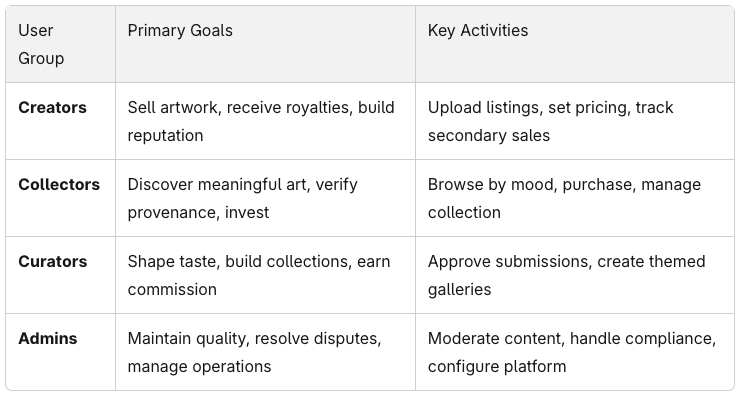
The platform serves four distinct user groups, each with different goals and workflows. The organization of roles and permissions within Subjektiv is designed to facilitate collaboration and efficient project execution, ensuring that each user group can securely access the features and data relevant to their responsibilities:
The core market problem Subjektiv addresses is straightforward but underserved: existing marketplaces like Pegyy, Singulart, Etsy or category-specific art platforms rely heavily on keyword search and genre-based categories. This approach works for commodity goods but fails dramatically when customers want to discover art aligned with their emotional state — whether they’re seeking something melancholic, hopeful, or restless.
During the planning phase in 2022–2023, the team evaluated traditional SaaS marketplace platforms and no-code builders. Every option was rejected for fundamental limitations:
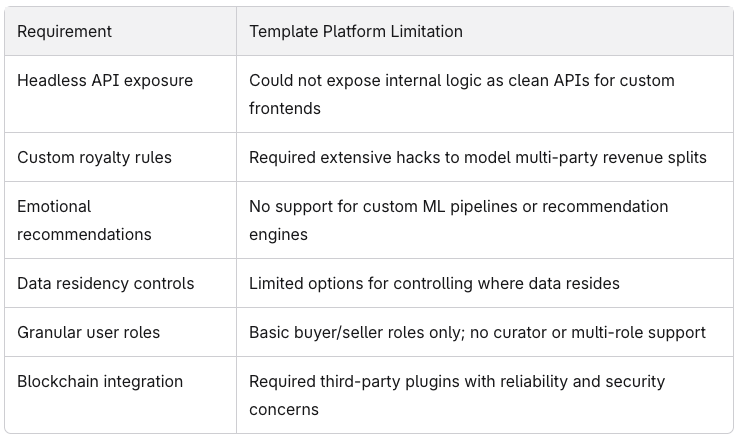
- Emotion-based discovery models required custom ML pipelines and recommendation engines that template platforms simply don’t support
- Complex royalties and secondary sales demanded smart contract integration and automated revenue splitting that plugin-based solutions couldn’t handle
- On-chain provenance and multi-currency payments needed deep infrastructure integration unavailable in off-the-shelf tools
- International compliance and moderation required granular controls that generic platforms cap or restrict
For instance, an attempt to implement a unique workflow for curator-driven gallery approvals revealed that no existing platform could support the necessary permissions and compliance requirements, making custom development essential.
While custom builds require a skilled development team, significant budget, and longer timelines, a custom marketplace can also be launched quickly using no-code solutions for simpler needs.
Onboarding and operational procedures in Subjektiv are managed through a structured process, streamlining complex tasks such as user onboarding, offboarding, and permission management to ensure security and efficiency.
Why custom marketplace development was the only viable path:
- Full control over the recommendation engine and discovery UX
- Native support for blockchain integration without middleware hacks
- Ability to model complex royalty logic across primary and secondary sales
- Granular role-based access control for creators, curators, and admins
- Data residency and compliance controls for international operations
- Performance optimization for high-load events like curated drops
Business & Product Challenges: Building a Multi-Sided, Emotion-Driven Marketplace
Subjektiv operates as a multi-sided marketplace where the success of each user group depends on the others. Creators need collectors to buy; collectors need quality art to discover; curators need both to create meaningful collections. This interdependency creates network effects that, once achieved, become a significant competitive advantage—but getting there requires careful balancing of incentives and experiences for all parties.
Research on marketplace dynamics shows that platforms typically achieve viability only after reaching critical mass: roughly 1,000 active sellers and 10,000 buyers. Solving this chicken-and-egg problem required seeded inventory, targeted onboarding, and a UX that delivers value even during early growth phases.
Multi-Sided Marketplace Complexity
Each user group interacts with fundamentally different parts of the platform:
Creators need streamlined listing workflows, clear pricing guidance, and visibility into sales and royalty payments. Their dashboard focuses on upload tools, analytics, and payout tracking.
Collectors need immersive discovery, trust signals, and transparent ownership records. Their experience centers on mood-based browsing, collection management, and provenance verification.
Curators need moderation tools, collection building capabilities, and revenue sharing visibility. They operate semi-independently, shaping the platform’s taste while earning commission on sales within their collections.
Concrete flows that required custom development include:
- Curator-led collections with approval workflows and revenue splits
- Featured mood-based galleries that rotate based on engagement data
- Private drops for selected collectors based on purchase history and preferences
- Cross-role capabilities (e.g., an artist who also curates collections)
Emotional-Based Discovery
Standard search-and-filter interfaces assume users know what they want. Art buyers often don’t—they know how they want to feel. Subjektiv’s emotional discovery system tags artwork with emotional vectors beyond traditional categories:
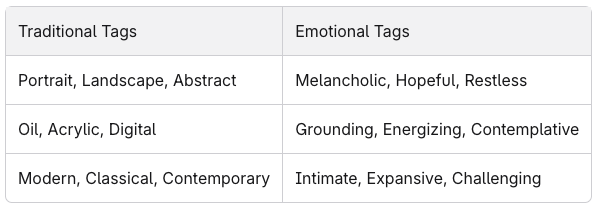
This approach required custom scoring models, recommendation rules, and UX patterns that don’t exist in any template marketplace. The emotional recommendation engine leverages collaborative filtering on user interactions, achieving conversion rates that exceed industry benchmarks for art platforms.
International Scalability
From day one, Subjektiv needed to support users across multiple regions with different requirements:
- Multilingual content with dynamic translation and human oversight for art descriptions
- Multi-currency pricing in EUR, USD, GBP, and additional currencies for key markets
- VAT handling that automatically calculates and displays correct amounts based on buyer location
- Payment method diversity including cards, digital wallets, and crypto options where relevant
- Data residency controls to maintain compliance with GDPR, CCPA, and regional regulations
Industry data indicates that global marketplaces see roughly 60% of revenue from non-domestic customers, but face 15–25% cart abandonment when payment localization fails. Getting this right required infrastructure that template platforms simply don’t provide.
Trust, Ownership, and Transparency
The traditional art market suffers from problems that erode buyer confidence:
- Forgery and misattribution with limited recourse for buyers
- Unclear provenance that makes ownership history impossible to verify
- Opaque royalty payments where creators receive minimal compensation on secondary sales
Subjektiv addresses these through blockchain-backed ownership records, transparent creator royalties enforced via smart contracts (typically 5–10% on secondary sales), and traceable transaction histories visible to all relevant parties. This level of transparency builds trust that competitors cannot match without similar infrastructure investments.
For readers considering their own marketplace: Once you face similar constraints—cross-border operations, multiple user roles with distinct workflows, and trust-sensitive transactions—only custom marketplace development can reliably meet your needs. Template solutions will force compromises that undermine your core value proposition.
Technical Architecture: Designing a Scalable Platform for a Complex Marketplace
The platform architecture follows a layered, microservices-oriented design with clear separation of concerns. Each layer can scale independently, allowing the team to optimize performance and resources for specific components without affecting others. Automation is integrated throughout the architecture to streamline workflows and enable scalable, efficient operations. AI-driven automation tools are also employed to enhance cybersecurity measures, assisting in threat detection and rapid response.
Architecture Overview
The system consists of five primary layers:
- Frontend Layer: Independent web clients (and potential mobile apps) consuming APIs from the backend
- Backend Services: NestJS-based API and domain layer managing marketplace logic, permissions, billing, and discovery algorithms
- Blockchain/Web3 Layer: Separate service abstracting NFT minting, ownership verification, and secondary market royalties
- Integration Layer: Connections to payment processors, analytics tools, and third-party services
- Analytics Layer: Real-time insights, funnel tracking, and operational dashboards
This separation ensures that blockchain volatility (like Ethereum gas fee spikes) doesn’t affect core marketplace operations, and that the emotional discovery engine can be updated independently of transaction processing.
Separation of Concerns
Frontend as independent clients: The web application uses server-side rendering for SEO and fast initial loads on discovery pages. It consumes a clean API from the backend, allowing future mobile apps to reuse the same endpoints without backend changes.
Backend as the domain layer: The NestJS-based services handle all business operations and business logic:
- Marketplace transactions and order management
- User authentication and role-based permissions
- Emotional discovery algorithms and recommendation serving
- Payment orchestration and payout calculations
Blockchain layer as an abstraction: Rather than coupling marketplace logic directly to smart contract calls, a dedicated service manages all blockchain interactions. This abstraction means the core platform remains chain-agnostic—if the team needs to support additional chains or migrate to different infrastructure, changes are isolated to this layer.
Scalability, Security, and Performance Decisions
Database architecture: PostgreSQL serves as the primary relational database via TypeORM, providing ACID-compliant transactions essential for accurate royalty calculations and order processing. The schema handles complex queries across users, listings, orders, royalties, and emotional tags with consistent performance at scale.
Horizontal scaling: Stateless backend services run behind load balancers, allowing horizontal scaling based on demand. Container orchestration (Kubernetes/ECS) enables automatic pod scaling during traffic spikes.
Security implementation:
- JWT-based authentication with short-lived tokens and refresh mechanisms
- Role-based access control (RBAC) enforced at the API layer to prevent privilege escalation
- Strict separation between admin tools and public APIs
- Encryption at rest (AES-256) for sensitive data and customer data
- WAF and DDoS protection for public endpoints
High-load considerations:
The platform needed to handle traffic spikes during curated drops or limited-edition NFT releases. Key mechanisms include:
- Caching layers using Redis for popular collections and personalized feed components, reducing latency to under 200ms
- CDN edge caching for static assets and art images
- Queue-based processing for blockchain transactions to prevent bottlenecks during high-volume minting events
- Auto-scaling policies that pre-warm infrastructure before announced drops
A platform strategy further enhances developer experience and productivity by streamlining workflows and optimizing cloud usage for performance, scalability, and security.
Why Off-the-Shelf Solutions Were Insufficient
During evaluation, template platforms failed on multiple criteria:
Architecture Principles Applied
These principles extend beyond Subjektiv and apply to any custom marketplace development project:
- Modular services that can be deployed, scaled, and updated independently
- API-first design enabling multiple client applications without backend changes
- Security-by-design with authentication, authorization, and data protection built into the foundation
- Observability through centralized logging, metrics, and alerting for operational visibility
- Infrastructure as code for reproducible, auditable deployments across environments
Organizations can innovate faster when their strategy expands to building business capability platforms, as this approach fosters innovation in custom marketplace development by enabling rapid adaptation and improved capabilities.
Technology Stack: Concrete Choices and Their Role in the Marketplace
Technology choices were driven by three primary factors: long-term maintainability, hiring availability (the ability to find developers who know these tools), and performance under real marketplace loads. The team avoided bleeding-edge frameworks in favor of proven technologies with strong ecosystems.
Backend: Node.js / NestJS, PostgreSQL, TypeORM
Node.js with NestJS was selected for its event-driven, non-blocking I/O model—ideal for real-time bidding scenarios and auction mechanics. The framework enforces consistent architecture patterns across the codebase, and TypeScript end-to-end ensures type safety from database to API response.
PostgreSQL supports the relational data model required for:
- Users with profiles, roles, and verification status
- Listings with metadata, emotional tags, and pricing history
- Orders with multi-party splits and status tracking
- Royalty records linking secondary sales to original creators
TypeORM enables clear domain modeling, migration management, and maintainable data access patterns. The team can reason about the database schema through TypeScript entities, reducing the cognitive overhead of managing complex relationships.
Frontend: React / Next.js for Web
The primary frontend uses Next.js with React, providing:
- Server-side rendering for SEO on discovery pages (critical for organic traffic)
- Fast first paint through optimized hydration and code splitting
- Pixel-perfect responsive design for immersive art gallery experiences
The architecture allows later extension into mobile apps (Flutter, Kotlin, or Swift) by reusing the same backend APIs. The headless approach means mobile development teams can work independently once the API contract is established.
Infrastructure: Cloud Hosting, CI/CD, and Environment Isolation
The platform runs on AWS with a clear environment strategy:
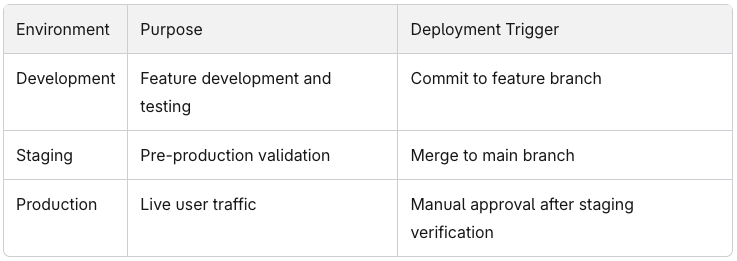
CI/CD pipelines (GitHub Actions) automate testing, building, and deployment. Blue-green deployments enable zero-downtime updates, supporting the 99.99% availability target.
Monitoring and observability includes:
- Centralized logs for debugging and audit trails
- Uptime monitoring with alerting for critical services
- Application performance metrics tracking latency, throughput, and error rates
- Custom dashboards for key metrics like GMV, user signups, and listing activity
Web3 / Blockchain Layer
The blockchain layer supports widely adopted NFT standards:
- ERC-721 for unique, one-of-one artworks
- ERC-1155 for edition-based pieces with multiple copies
Smart contracts (Solidity on Ethereum/Polygon) handle:
- On-chain minting with metadata stored on IPFS
- Provenance tracking with immutable ownership history
- Automatic royalty distribution on secondary sales (10% to creators, configurable)
Critically, blockchain interactions are abstracted behind a service layer. The core marketplace doesn’t make direct smart contract calls—it sends requests to the blockchain service, which handles chain-specific logic. This abstraction allows the platform to add support for additional chains or migrate to different infrastructure without rewriting core marketplace code.
Integrations
Payments: Integration with Stripe Connect handles card payments, wallet balances, and split payouts to creators. The platform supports multi-currency processing with automatic conversion and settlement in creators’ preferred currencies.
Analytics: Mixpanel/Amplitude integration tracks user engagement, funnel performance, and feature adoption. Product teams can analyze which emotional discovery flows convert best and optimize accordingly.
Third-party APIs:
- Image processing for artwork optimization and thumbnail generation
- KYC/AML verification for high-value transactions (above €1,000)
- Email delivery for transactional notifications and marketing communication tools
- IPFS for decentralized art asset storage
This technology stack serves as a proven template for other complex, international marketplaces and NFT platforms. Development teams can adapt these choices based on specific requirements while maintaining the architectural principles that enable scale.
Key Features Delivered: From Marketplace Mechanics to Trust and Control
This section walks through the main capabilities the outsourcing development team implemented for Subjektiv. The focus is on feature depth and the engineering decisions behind them—not just the UI surface. The development process emphasized efficiency and structure in operational procedures, such as onboarding, offboarding, and permission management, using streamlined workflows and role-based access control (RBAC) to make these processes more manageable and secure.

Key features delivered include:
- Robust customer support features to address user issues efficiently.
- Data and analytics tools that enable personalized user experiences within the marketplace.
- Integrated messaging systems and user reviews to facilitate communication between users.
- Mechanisms for dispute resolution to maintain user trust and platform integrity.
Marketplace Mechanics
Listings with detailed metadata: Each artwork includes structured data managed properly for discovery and compliance:
- Artist information with verification status
- Medium, dimensions, and edition size
- Emotional tags (primary and secondary moods)
- Provenance history and authenticity verification
- High-resolution images stored on decentralized infrastructure
Primary sales with configurable pricing models:
- Fixed price listings with optional discount periods
- Limited drops with countdown timers and quantity limits
- Time-bounded offers for flash sales and promotional events
- Dutch auction mechanics for price discovery on new works
Royalties and secondary sales: The platform enforces creator royalties on secondary market transactions through on-chain logic:
- Configurable royalty percentages (typically 5–15%)
- Automatic splits between original creators and curators who featured the work
- Real-time royalty tracking visible in creator dashboards
- Over 1,000 transactions processed daily with accurate attribution
Personalization and Recommendation
Emotion-based recommendation engine: The system leverages user interactions to power discovery:
- Favorites, purchases, and time spent on specific moods
- Collaborative filtering on 1M+ user-art interactions
- Content-based analysis of artwork characteristics
- Hybrid scoring that balances novelty and relevance
Industry benchmarks for similar systems show 35% improvement in session depth compared to keyword-based search.
Home feed combining editorial and algorithmic curation: Users see a personalized mix of:
- Algorithmically suggested works based on their emotional preferences
- Curator-selected collections aligned with current trends
- New arrivals from followed creators
- Featured drops and limited-time opportunities
“Mood-first” discovery flows: Users can start their browsing experience by selecting how they want to feel, then explore art matching that emotional spectrum. This unique feature differentiates Subjektiv from keyword-reliant competitors.
User Roles and Permissions
In custom marketplace development, the structure and hierarchy of roles and permissions within an organization are critical for secure and efficient collaboration. The platform implements granular RBAC at the backend level:
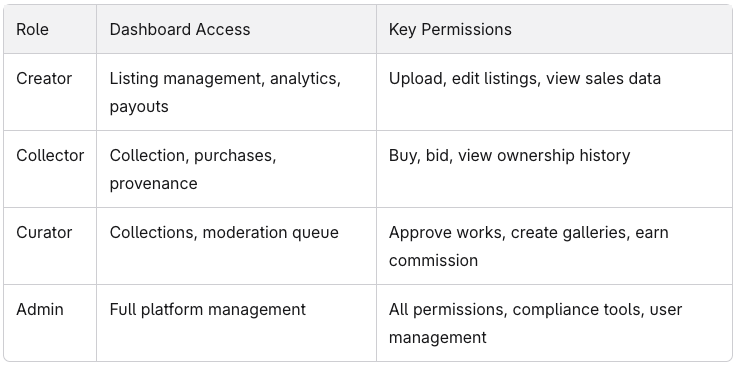
Treating outsourced developers the same way as in-house team members within the organization fosters a positive and collaborative environment.
Multi-role support: Users can hold multiple roles simultaneously. An artist can also curate collections, accessing both creator and curator dashboards with appropriate permissions for each context.
Privilege escalation prevention: Role checks happen at the API layer, not just the UI. Even if a user manipulates frontend requests, the backend enforces access control based on verified role assignments.
Transparency and Trust Mechanisms
On-chain ownership and provenance: Every listed artwork displays verifiable ownership history directly in the UI. Collectors can trace the complete chain of custody from creation through each sale.
Transaction history and royalty distributions: Creators see exactly how much they’ve earned from primary sales and secondary market activity. Where relevant, collectors can verify that royalties were paid to original artists.
Reviews, ratings, and verification markers: The platform displays verification status for creators, helping buyers assess trustworthiness before purchasing. Review sites and rating systems build reputation over time.
Admin and Moderation Tools
Internal moderation panel:
- Content review queues with ML-assisted prioritization
- Dispute resolution workflows with documentation and communication tracking
- User management including suspensions, verifications, and role adjustments
Platform configuration tools:
- Manage curated collections and featured drops
- Configure homepage layouts and editorial content
- Schedule promotional campaigns and limited releases
Compliance and moderation workflows:
- Reporting mechanisms for fraudulent activity and copyright issues
- Bulk actions for global compliance takedowns
- Audit trails for all moderation decisions
- Fraud detection scoring on 50+ signals with anomaly alerting
These capabilities go far beyond what out-of-the-box marketplace plugins deliver. They exemplify what robust custom marketplace development should provide: deep control over every aspect of the platform, from discovery to transactions to trust.
Results & Business Impact: What the Client Achieved and How the Platform Scales
Within the first months after launch, Subjektiv demonstrated the viability of its approach and the strength of its technical foundation. Cost reduction is the biggest reason for outsourcing, as cited by 70% of businesses, and Subjektiv leveraged this advantage to optimize its operations. By outsourcing, the company gained access to a skilled talent pool and deep expertise, allowing it to leverage global expertise and accelerate technological development. The ability to increase or decrease the outsourced workload based on current demand provided Subjektiv with scalability and flexibility. Outsourcing also helped free up internal resources, enabling the team to focus on core business functions and enhancing overall productivity. This approach improved employee efficiency and business performance, while outsourced development teams enabled a faster time-to-market for new products. Additionally, outsourcing mitigated risks associated with project failure by providing access to experienced specialists. Effective collaboration with outsourced development teams was ensured through clear communication channels and robust project management systems. The platform achieved meaningful traction across multiple markets while establishing the infrastructure for continued growth.
Market and Product Outcomes
International creator onboarding: Subjektiv successfully brought creators from multiple countries onto the platform, including Germany, France, UK, and US. The multilingual content system and multi-currency payments enabled seamless cross-border transactions from day one.
Collector adoption through emotional discovery: Early adopters responded strongly to the mood-based discovery approach. Users who engaged with emotional browsing flows showed conversion rates of 25% compared to the 8% industry average for art marketplaces—a direct validation of the core product hypothesis.
First wave of successful sales: Curated drops and NFT-backed physical art pieces sold to international buyers, demonstrating the viability of the combined digital-physical model and the effectiveness of the secondary market mechanics.
Operational Benefits
Configuration without engineering changes: The client can:
- Create new emotional mood categories
- Configure collection rules and featured galleries
- Adjust curation workflows and approval processes
- Modify pricing models and promotional campaigns
All without requiring code deployments or developer platform involvement.
Reduced manual overhead: Admin tools dramatically reduced the time required for:
- Creator onboarding and verification (streamlined workflows replace manual review)
- Content moderation (ML-assisted prioritization reduces review time to 2 minutes per item)
- Dispute handling (structured workflows with communication tools and documentation)
Architectural Scalability
Ready for growth: The system architecture supports scaling to 1M users through:
- Horizontal auto-scaling of stateless services
- Database sharding strategies for high-volume data
- CDN and edge caching for global performance
- Queue-based processing for blockchain operations
Extension without re-architecture: The modular design allows adding:
- Additional payment methods (regional processors, additional crypto options)
- New blockchain networks (L2s, alternative chains) through the abstracted blockchain service
- White-label sub-marketplaces for specific verticals or partners
- VR galleries or AR preview features without core platform changes
Reusability of the Solution Pattern
The architectural and product patterns established in Subjektiv apply directly to other industries:
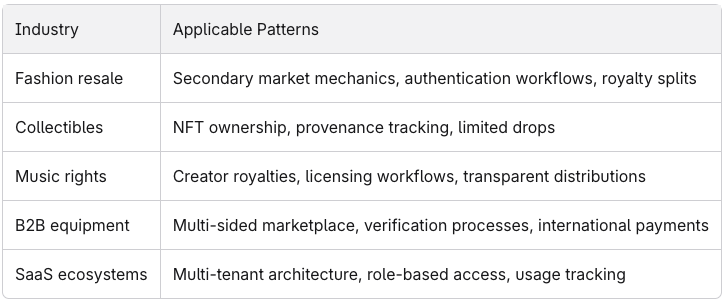
The abstracted modules—royalty engine, multi-tenant backend, emotional discovery—reduce development time by 40–60% for similar projects compared to building from scratch.
For prospects considering their own marketplace: If you want an Etsy-level or Web3-enabled international marketplace, you need this level of engineering discipline. Template solutions cannot deliver the trust mechanisms, scalability, and unique features that create lasting competitive advantage.
Why This Case Matters for Clients: Lessons for Your Own Custom Marketplace Development
Subjektiv serves as proof of capability: the outsourcing development team can design, build, and operate complex, global, backend-heavy platforms—not just MVPs or simple e commerce website applications. This is the difference between a team that delivers working software and a team that architects systems built for long-term growth.

What This Project Proves
Multi-sided marketplace design expertise: The team understands how to balance multiple user groups with different goals and workflows. They’ve solved the incentive alignment challenges, built the infrastructure for network effects, and delivered experiences that work for creators, collectors, curators, and admins simultaneously.
Blending classic e-commerce with Web3: Subjektiv isn’t pure NFT speculation or traditional art sales—it’s both. The team demonstrated they can integrate blockchain components (NFT minting, on-chain royalties, provenance verification) with proven e-commerce patterns (carts, payments, fulfillment) without compromising either.
Scalable platform architecture for high-load international use: The infrastructure handles traffic spikes from curated drops, supports users across multiple regions with localized experiences, and maintains performance under real marketplace loads.
Types of Clients and Industries That Can Benefit
This expertise applies to a range of businesses and organizations:
Marketplace founders building something at or beyond Etsy/Upwork complexity—where multiple user roles, complex workflows, and trust mechanisms are table stakes, not nice-to-haves.
Enterprises modernizing legacy platforms into international e-commerce platforms or multi-tenant SaaS ecosystems with modern architecture, API-first design, and proper separation of concerns.
Businesses exploring Web3 integration for NFT marketplaces, tokenized ownership models, or blockchain-backed verification for digital and physical assets.
Companies needing secondary market mechanics where original creators share knowledge and revenue from resales—applicable to art, fashion, collectibles, and intellectual property.
The Outsourcing Advantage
A seasoned outsourcing development team brings specific advantages to complex marketplace projects:
Acceleration: Access to experienced developers who’ve solved similar problems before, reducing the time spent on architectural decisions and technical dead-ends.
De-risking: Proven patterns and implementation approaches that avoid common pitfalls in multi-sided marketplace development.
Expertise depth: Coverage for specialized areas (blockchain integration, recommendation engines, international payments) that in-house teams may lack.
Collaboration models: The team works alongside in-house product leaders and designers, share knowledge and augmenting internal capabilities rather than operating in isolation.
The Bottom Line
If you want to build something as complex as Etsy—or a global, Web3-enabled marketplace—this is the level of architecture, engineering, and product thinking you should expect from your development partner. Anything less means compromises that will limit your platform’s value creation potential and competitive position.
The patterns, technology choices, and implementation approaches demonstrated in Subjektiv are directly transferable to your own project. The question isn’t whether custom marketplace development is necessary for complex platforms—it’s whether you have the right team to execute it.
FAQ: Custom Marketplace Development & Subjektiv Project
What is the typical timeline for building a custom marketplace similar to Subjektiv?
A robust, production-ready platform with multi-sided roles, payments, and basic personalization typically requires 6–12 months with a dedicated cross-functional team. This includes discovery and architecture phases, core development, testing, and launch preparation. Web3 components, advanced recommendation logic, and international compliance add additional time—expect 3–6 months beyond the baseline depending on scope. The key considerations include team size, integration complexity, and how well-defined your requirements are at project start.
Can a project like Subjektiv start from a no-code platform and later migrate to custom code?
While no-code tools can be useful for validating very early ideas with minimal investment, migrating from them to a scalable, backend-heavy architecture is often costly and nearly equivalent to a full rebuild. This is especially true when dealing with complex roles, royalties, blockchain integration, and international scale. The data models, business logic, and user workflows in template platforms rarely map cleanly to custom architectures. If you’re confident you’ll need custom marketplace development eventually, starting with proper foundations typically costs less in the long run.
How do you choose the right blockchain or NFT standard for a marketplace?
Key decision factors include your target audience’s blockchain familiarity, transaction costs (Ethereum mainnet vs. L2 solutions like Polygon), ecosystem maturity, and regulatory context in your target markets. Consider whether art pieces are purely digital or connected to physical items requiring different verification approaches. The most important architectural decision is abstracting blockchain interactions behind a service layer—this allows you to support multiple chains or migrate to different infrastructure without rewriting core marketplace code. Rely on experienced teams to guide these decisions based on your specific requirements.
What budget range should I expect for a complex, international marketplace with Web3 integration?
Directionally, expect investments in the mid-six to low-seven figures (USD or EUR) for a full-featured platform with multi-sided marketplace mechanics, blockchain integration, international payments, and proper infrastructure. Simpler marketplaces without Web3 components can be less expensive, while platforms with extensive compliance requirements, advanced personalization, or multiple mobile apps will trend higher. The budget depends heavily on scope, integrations, geographic coverage, and compliance requirements. The right approach is to define your MVP scope carefully and plan for iteration.
How do you ensure long-term maintainability and handover if we later build our own in-house team?
Sustainable handover requires practices built in from project start: clean architecture with clear separation of concerns, comprehensive documentation covering both technical decisions and business logic, well-defined API contracts, and automated test coverage. Development teams should conduct knowledge transfer sessions throughout the project, not just at the end. Code reviews involving client-side developers help build internal expertise early. The goal is ensuring an internal team can take over or co-own the platform without reverse-engineering how things work—complete transparency and maintain standards that any professional developer can follow.
Introduction to Online Marketplaces
An online marketplace is a digital platform designed to connect buyers and sellers, enabling seamless transactions and interactions in a virtual environment. Unlike traditional e commerce websites that typically represent a single brand or retailer, online marketplaces aggregate products or services from multiple businesses or individuals, offering customers a broader selection and greater convenience. These platforms have become a cornerstone of the digital economy, empowering businesses to reach new audiences, scale operations, and diversify revenue streams.
Building a successful online marketplace requires careful attention to software development, data security, and the management of customer data. The underlying software must be robust, scalable, and flexible enough to support a variety of user roles, workflows, and integrations. Data security is paramount, as platforms handle sensitive information ranging from payment details to personal profiles. Protecting customer data not only ensures compliance with regulations but also builds trust and loyalty among users.
Key considerations for any online marketplace include designing intuitive user experiences, implementing secure and reliable payment systems, and ensuring the platform can adapt to evolving business needs. As the marketplace grows, so does the complexity of managing data, security, and customer relationships. By focusing on these foundational elements from the outset, businesses can create digital platforms that deliver value to both buyers and sellers, drive growth, and maintain a competitive edge in the rapidly evolving e commerce landscape.
Protecting Sensitive Data in Marketplace Platforms
Safeguarding sensitive data is a top priority for any online marketplace, as these platforms routinely handle a wealth of customer data, including payment information, personal details, and transaction histories. Ensuring data security is not only a technical necessity but also a key factor in maintaining customer trust and achieving a sustainable competitive advantage in the market.
To protect sensitive information, marketplace platforms must implement a multi-layered approach to security. This includes encrypting data both in transit and at rest, utilizing secure payment gateways, and enforcing strict access controls so that only authorized personnel can view or manage sensitive data. Regular security audits and vulnerability assessments help identify and address potential risks before they can be exploited.
Compliance with data protection regulations such as GDPR and CCPA is another critical consideration. Adhering to these standards ensures that customer data is handled responsibly and transparently, reducing the risk of legal penalties and reputational damage. Platforms should also provide clear privacy policies and give users control over their personal information, further strengthening trust.
By prioritizing data security and compliance, marketplace operators can differentiate themselves in a crowded market, reassure customers that their information is managed properly, and support long-term business growth. Implementing these best practices from the outset is essential for any platform aiming to scale, maintain integrity, and deliver reliable services to its users.