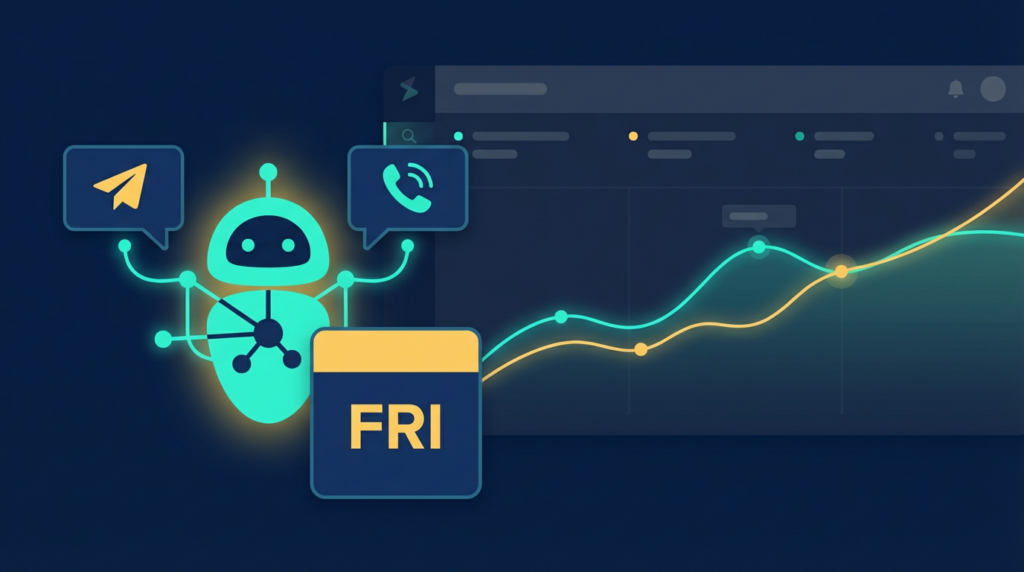
It is Friday afternoon. You can almost hear the office volume drop.
But in Telegram and WhatsApp, something else is happening:
Lead messages keep arriving. And while your team is closing tickets, potential customers are trying to solve one problem fast: “Do you have availability?” “What is the price?” “Which master can do this?” “Can I book for tomorrow?”
When responses are slow, inconsistent, or scattered between inboxes, something expensive quietly accumulates:
communication debt.
It is not the kind of debt you can refactor next sprint. It is the kind that turns intent into silence. It turns “just asking” into “never coming back.” And it turns a product growth story into a weekly mystery.
This is exactly where an AI agent for sales conversations changes the game.
At the core, we are not “adding AI.” We are building a better conversation system: reliable, measurable, and designed to drive outcomes. The kind of system you would actually be proud to ship in engineering.
If you want an example of what this looks like in practice, check Sales AI (Telegram + sales workflows end-to-end).
The real problem is not your product. It is your conversation pipeline.
Engineering teams are great at building pipelines:
- Input arrives.
- Validation happens.
- Work is routed.
- Output is produced.
- Metrics confirm the result.
In many sales and customer communication flows, the pipeline exists too, but it is hidden in chat.
Incoming message -> human reading -> human context switching -> manual typing -> manual transfer to another tool -> delay -> missed opportunity.
That pipeline is fragile because it is made of human attention, not system design.
On Monday, you can tolerate it. On Friday, it becomes painful.
Here is what we usually see inside Telegram and WhatsApp sales conversations:
- No SLA for replies. People want answers now, not “later today.”
- Inconsistent answers across operators. Same question, different completeness and follow-up.
- Qualification and booking are manual. The chat ends before the scheduling system moves.
- No feedback loop. You guess why customers drop off instead of measuring it.
The result is predictable: you build the offering, but revenue leaks in the conversation layer.
What an AI sales agent should do in a bot (and why it feels like engineering)
An AI agent inside Telegram/WhatsApp should behave like a competent teammate, not like a chatbot that “talks a lot.”
The winning behavior pattern looks like this:
1) Reply fast, within a predictable window
Customers expect speed in chat. The agent replies immediately with structured answers (price, time, service details) and, when something is missing, asks the next question to finish qualification and route toward booking. That turns “I asked and waited” into “I got clarity and booked.”
2) Qualify intent (without annoying the customer)
Qualification is not interrogation. In good sales engineering, it is data collection that enables the next step.
An AI agent asks only for what makes booking possible: service, preferred time, and key constraints (duration, preferences, special requirements). Behind the scenes, it converges toward a booking-ready request instead of guessing.
3) Recommend the right option (and make the upsell feel helpful)
Most businesses do not need “more upsells.” They need recommendations that match context.
It recommends the best option based on service and constraints, plus a small relevant upsell when it improves the outcome. Friday goal: end with a booking suggestion, not a sales pitch.
4) Integrate with your scheduling/booking system (so the dialogue becomes action)
Conversations only become revenue when the system executes the next step.
Integrate with your scheduling/booking system: availability, customer details, confirmations/reminders, and rescheduling rules. In other words: chat should trigger real operations, not just “DM support.” End-to-end delivery means setup + integrations + handoff logic + scenario safeguards.
5) Hand complex cases to humans (quality is a feature)
AI should not pretend it can handle everything.
For edge cases and low confidence (complaints, unusual requirements, pricing exceptions), the agent asks a targeted follow-up, summarizes context, and hands off to a human with a clean request payload. Operators move faster, because the routine is already done.
The Friday growth test: can you measure conversation-to-booking?
Engineering teams are allergic to “we think it helped.”
In sales bots, the same rule should apply. The system should be measurable.
A practical KPI chain looks like:
- conversations started
- first response time
- qualified requests
- booking created
- reasons for drop-off
This is where communication becomes a business outcome: improve the assistant flow, and bookings go up (measurably).
MCP-style sequence thinking for your conversation agent (a system, not vibes)
When we talk about “agentic AI,” it is easy to get lost in the hype.
But inside your organization, the solution still needs the same structure you use for product delivery: clear inputs, predictable outputs, and feedback loops.
Here is a simple MCP-style sequence thinking approach for building AI sales communication in Telegram and WhatsApp.
Step 1: Map the communication graph (where intent goes to die)
We start by understanding how information actually flows today:
- Where do leads come from (ads, site, referrals, organic)?
- What do they ask first in Telegram/WhatsApp?
- Where are the longest delays?
- Who takes over for edge cases?
You are looking for the real failure points, not the theoretical process.
Step 2: Define “value” as a booking-ready output
Before changing messaging, define success in concrete terms:
- What is the final output of the conversation?
- a booking created
- a confirmed service choice
- or a handoff to an operator with complete context
- What are the acceptance criteria?
- required fields gathered
- no ambiguous appointment requests
- correct routing to the right schedule system
When value is defined, the assistant can be trained (and constrained) toward it.
Step 3: Design communication contracts (what the bot guarantees)
The bot should have explicit “contracts,” like engineering interfaces:
- If a customer asks about price, the bot replies with the correct structure and asks a follow-up if needed.
- If availability is requested, the bot offers slots or explains constraints.
- If the customer wants to reschedule, the bot follows rescheduling rules.
- If confidence is low, the bot handoffs with a clear summary.
This prevents hallucination-like behavior and keeps the experience consistent.
Step 4: Integrate the execution layer (chat triggers the operation)
The assistant is only as good as its ability to act.
So integrate:
- booking and calendar availability
- customer profile capture
- reminders and confirmations
- analytics events (conversation milestones)
Now the bot is not “answering.” It is executing.
Step 5: Add feedback loops that survive busy season
Your bot should improve over time, not just launch once.
Practical feedback loops:
- weekly review of drop-off reasons
- scenario performance measurement
- A/B tests on the wording of recommendations
- operator feedback on edge cases
- continuous scenario updates based on real conversations
This turns Friday traffic into Monday learning.
What “end-to-end” delivery means in Sales AI terms
If you are adopting an AI sales agent, “end-to-end” should mean the whole pipeline is handled, not just the LLM.
Typically it includes:
- Telegram and/or WhatsApp bot connection
- setup and baseline communication rules
- Integration with your scheduling and service catalog
- services, masters/agents, and available windows
- Scenario engineering
- automated replies for common questions
- qualification flow
- recommendation and upsell logic
- handoff rules for complex cases
- Automation after booking
- reminders
- confirmations
- rescheduling
- Quality control and analytics
- conversion and response time metrics
- visibility into where customers drop off
At Sales AI, the emphasis is on reducing chaos in chat while increasing conversion through automation and integration.
Real-world use cases (inside Telegram and WhatsApp)
To make it tangible, here are the most common outcomes businesses pursue with Telegram/WhatsApp AI sales agents.
Case 1: “We respond, but too late” -> AI answers immediately and routes to booking
Problem:
Customers message after hours or when your team is busy.
AI outcome:
Instant responses for typical questions.
Quick collection of required details.
Booking-ready flow instead of open-ended chat.
Engineering outcome:
Predictable latency and clear routing logic.
Less context switching for humans.
Case 2: “Operators give different answers” -> consistent recommendations and script logic
Problem:
Different admins answer with different wording, missing details or forgetting follow-ups.
AI outcome:
Standardized responses and structured qualification.
Clear guidance and consistent next steps.
Engineering outcome:
One source of conversation truth (with versioned scenarios).
Case 3: “People ask, but don’t commit” -> qualifying questions + best-option recommendations
Problem:
Customers browse options in chat but never book.
AI outcome:
The agent converges toward a decision:
service + time + preferred master/agent + constraints.
Engineering outcome:
Conversation becomes a conversion funnel, not a support thread.
Case 4: “Bookings happen, but no-shows kill revenue” -> reminders and follow-ups
Problem:
Confirmed customers still disappear.
AI outcome:
Automated reminders and confirmations.
Support for rescheduling.
Engineering outcome:
Better reliability through automation and consistent scheduling events.
The growth hook for engineering leaders: make “customer conversations” a real product surface
Engineering is often judged by output: tickets shipped, features delivered, bugs fixed.
But if the product growth depends on customer conversations and chat experiences, then those conversations are part of the product.
Treat them like you treat the rest of the system:
- build for reliability
- instrument for learning
- design interfaces
- ensure handoffs are safe
- improve through feedback loops
That is how you turn Friday from “we survived another sprint” into “we shipped a success story.”
Call to action
If your Telegram and WhatsApp channels are full of half-finished conversations, the solution is not “more effort.”
It is a better conversation pipeline.
This is what Sales AI delivers end-to-end: AI agents that resolve typical sales communication, convert messages into bookings, and keep complex cases under human quality.
Want to see what your specific bot scenarios could look like?
Book a demo and we will map your current conversation graph into a measurable growth system.
keywords: AI agent, Telegram bot, WhatsApp bot, sales automation, lead conversion, customer communication, engineering mindset, business outcomes